Best Air Fryer Starter Kits for New Homeowners
By Maria López • 19th Feb
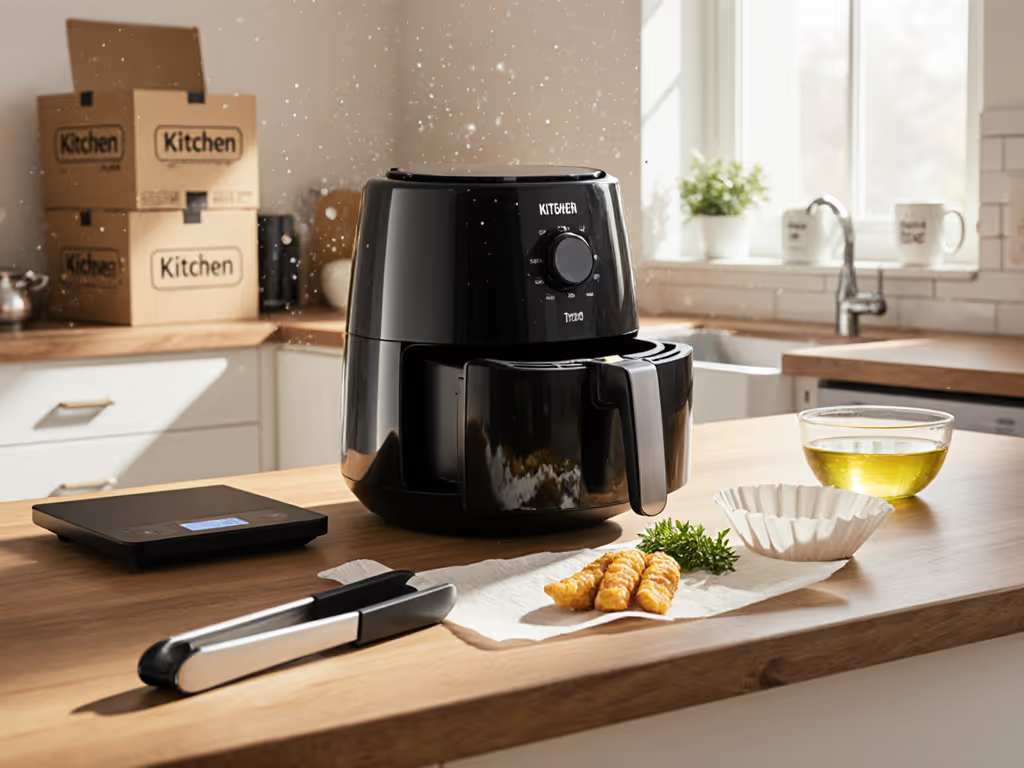
Setting up a new kitchen as a first-time homeowner or relocating to a fresh space puts you at a crossroads: invest in a full-size oven's electricity bill and heat output, or choose a basket air fryer that handles weeknight dinners faster and cooler. For a deeper look at this choice, see our basket vs oven air fryer guide. The real question isn't which model wins a YouTube comparison, it's which air fryer starter kit for new home matches your portions, space, and actual meal rhythm. I learned this the hard way after chasing a doorbuster deal, only to spend more on liners, extra baskets, and electricity corrections than the thoughtful unit I'd skipped would have cost over three years. After building a price-to-portion calculator and running the numbers for dozens of households, I stopped treating appliances as bargains and started treating them as throughput investments. Fit the food, then the budget.
For new homeowners, the stakes are higher than for a kitchen refresh. You're building a system that will anchor your weeknight rhythm, shape your meal prep, and sit on your counter for years. A wrong choice means either perpetual batch cooking for a family of four, or owning an oversized unit that collects dust in a tiny apartment. This guide walks you through proven basket air fryer options, breaks down hidden accessory and energy costs, and gives you clear yes/no gates to match capacity to your household.
Why New Homeowners Need a Different Framing
New home kitchen setup is not about buzzwords. It's about throughput math. A busy couple with one toddler cares about fitting a sheet pan of chicken tenders, a tray of fries, and a small vegetable basket in one shot, or committing to a two-batch plan with a clear holding strategy. An empty nester downsizing to a condo cares about not heating the kitchen in summer and fitting the unit in 10 inches of counter depth. A college grad sharing a rental with roommates cares about not hogging the kitchen for 30 minutes and keeping the noise down after work.
Online reviews rarely address these realities. They praise aesthetic design, app features, and brand loyalty. They ignore cost-to-portion, the true hidden cost of accessories, and whether you'll actually use the 13-function digital display or just hit "air fry" every time. According to independent testing by multiple cooking labs, the models that dominate comparison tests do so because they handle the core task (crisping, browning, even heat) reliably. Everything else is comfort or distraction.
The Starter Kit Framework: What Actually Belongs in Your Box
An air fryer bundle for first home should include five core items:
- The main unit matched to your household size
- A baking sheet or insert rack (to double usable area without buying a dual-zone)
- A drip liner or fat catch tray (reduces smoke and cleanup, often omitted from basic models)
- An oven mitt or silicone gripper (baskets run 400°F+; burns are real)
- A plain-language quick-reference chart for oven-to-air-fryer conversions
Notice what's not on that list: WiFi app, viewing window, smart alerts, or multiple basket options. These feel premium but rarely translate to better food or less total time at the stove. Buy once means matching portions, not chasing promo watts. The $60 compact model and the $350 smart oven both crisp chicken. One fits a dorm room; one replaces your countertop oven. Choose the right category first, then optimize within it.
1. Solo or Couple Household (1-2 Portions Average): The Compact Starter
Right-size: 2-2.4 quart capacity
If you cook for yourself or a partner most nights, a compact basket air fryer eliminates kitchen heat, countertop clutter, and the guilt of running a full oven for four chicken breasts. Capacity anxiety is real here: a 1.8-quart model will hold about four large chicken wings in a single layer, or 1.5 cups of chopped vegetables, or six medium egg rolls. If you're unsure what size you need, start with our small air fryer size guide for portion-by-portion clarity. Two batches happen fast, about 8 minutes per batch at 375°F plus preheat.
Monthly cost at a glance:
- Unit cost over 3 years: ~$3/month
- Electricity per 30-meal cycle (assuming 15 min per meal): ~$2-3/month
- Accessories and replacements: ~$1/month
- Total: ~$6-7/month for two people
A comparison: running a conventional oven for 15 minutes costs 2-3x as much in electricity and heats your kitchen another 10°F in summer. For the full breakdown of savings and texture trade-offs, read our air fryer vs oven efficiency comparison.
Compact-range options:
- Entry ($60): Basic dial controls, four preset functions, dishwasher-safe basket. No viewing window or accessories. One-year warranty.
- Mid ($130-160): WiFi app monitoring, glass viewing panel, 9-in-1 preset cooking modes. Slightly larger footprint.
Decision gate for this tier:
- Do you have a kitchen under 80 square feet or live in a space where heat matters (apartment, RV, dorm)? Yes → consider compact.
- Do you meal-prep for five+ people weekly? No → compact works.
- Do you reheat/dehydrate snacks regularly? Yes → the $130+ model's extra presets pay off.
The honest caveat: Cooking for more than two adults in one service means staggered plating. Your first batch sits on a warm plate while the second cooks. If you're feeding guests or a full family, jump to tier 2 or tier 3.
2. Young Family or Household of 3-4 (Standard Throughput): The Sweet-Spot Starter
Right-size: 5-6 quart capacity with square or rectangular basket
This is the workhorse tier. A 6-quart square basket holds 12-16 chicken wings in a single layer, or a full sheet pan of fries and vegetables side by side, or an entire rotisserie chicken. You fit a real dinner on one tray. One batch, one timer, one cleanup.
Cost breakdown per portion:
- For a family of four eating air-fryer dinners 4 nights/week:
- Unit cost (3-year spread): ~$3/month
- Electricity: ~$4-5/month
- Accessories and liners: ~$2/month
- Total: ~$9-10/month (or ~$0.50 per completed meal per person)
Compare that to a restaurant meal (~$12-15 per person) or a full-oven dinner prep (double the electricity, heat loss, and prep cleanup).
Standard-range options:
- Budget ($100): Intuitive touchscreen, square nonstick basket, 6 preset functions, audible mid-cook reminder, one-year warranty. This model wins independent testing because it just works.
- Mid ($120-130): Larger footprint, 6-7 color choices, or smart app with remote monitoring. Same core performance, different comfort layer.
- Upper ($180): Dual baskets (cook two separate foods at once), extended warranty, or premium materials (stainless steel casing). True game-changer for families with varied appetites. See our dual-basket vs single-basket test to gauge real-world time savings and capacity.
Per-portion usable capacity (real-world testing):
- Chicken breasts: 4-5 per batch, ~3 oz each
- Wings: 12-16 per batch, ~1 oz each
- Fries or veggies: 2-3 cups, packed
- Frozen appetizers: 30-40 pieces, depending on size
Decision gate for this tier:
- Do you have 3-5 people in the household, or cook family meals 4+ nights/week? Yes → this tier pays for itself.
- Is your kitchen counter 24+ inches deep? Yes → standard basket fits.
- Do family members have conflicting tastes (one wants meat, one wants veggies, one wants gluten-free)? Yes → the dual-basket model ($180) justifies the premium.
The hidden cost flag: Standard units often ship without a drip liner. Adding one (~$15-20) cuts cleanup time by 40% and prevents smoke buildup. Budget for it upfront.
3. Downsizers, Empty Nesters, or Heavy Batch-Prep Cooks: The Premium or Specialized Starter
Right-size: 8-13 quart capacity, or dual-basket systems, or countertop oven replacement
If you're downsizing from a full kitchen and want one appliance to air fry, bake, roast, and broil (replacing your aging toaster oven), a high-capacity or multi-function unit saves space and energy. Similarly, if you batch-prep 20 chicken breasts on Sunday for the week, a larger basket or dual-basket system cuts your prep time in half and keeps first batches warm while last ones cook.
Cost breakdown (heavy user, 8+ air-fryer dinners per week):
- Unit cost (3-year spread): ~$5-15/month depending on model
- Electricity: ~$8-12/month (higher capacity, longer cooks)
- Accessories (replacement baskets, premium liners): ~$3-5/month
- Total: ~$16-30/month (or ~$0.40-0.60 per completed meal per person)
So it's not cheaper on a per-meal basis, but the convenience of one-pass batch cooking and oven replacement often justifies it for households that meal-prep or cook multiple recipes in parallel.
Premium-range options:
- High-capacity single ($130-160): 8-10 quart baskets, more robust heating, often with glass viewing panels.
- Dual-basket ($180): Two independent baskets, Smart Finish feature (one finishes while the other continues), two-year warranty.
- Oven replacement ($350): 13 cooking functions, replaces toaster oven, convection speed, larger interior, premium materials. Best for downsizers or serious home cooks.
Accessory ecosystem matters here: Larger units often accept stacking racks, rotisserie spits, baking pans, and skewers. Before buying, check if the manufacturer sells a verified accessory bundle. A $30 stacking rack that fits and adds 40% usable area is worth it. A $40 proprietary basket that only fits this model is not.
Decision gate for this tier:
- Do you cook 8+ air-fryer dinners per week, or batch-prep 15+ portions on weekends? Yes → high-capacity or dual-basket justified.
- Are you replacing a toaster oven or full-size oven in a small home/condo? Yes → the $350 oven-replacement model saves total appliance count.
- Do you dehydrate, broil, or roast frequently? Yes → the 13-function model pays dividends.
- Is your counter space unlimited? No → stick to compact or standard tier.
The Accessory Trap: What to Bundle and What to Skip
When hunting an air fryer bundle for first home, resist the urge to buy five accessories upfront. Most kitchens only use three:
- Drip liner or fat catch (~$12-20): Reduces cleanup and smoke. Buy this immediately.
- Stacking rack (~$20-30): Genuinely doubles usable area. Worth it if the model accepts it. Not sure which add-ons actually help? Check our tested air fryer accessories guide for fit notes and value rankings.
- Replacement basket or secondary basket (~$40-60): Only if you're cooking for 5+ people regularly.
Skip:
- Proprietary "air fryer recipe" books (use YouTube or your oven cookbook, conversions are the same)
- Additional color/design baskets (nonstick coatings don't last through repeated use anyway)
- WiFi thermometers (your air fryer has temperature control; a separate probe adds complexity)
I once chased a deal on an air fryer that included six accessories I'd never touch. Returned two, left two in the box, and cleaned the same two over and over. Matching capacity and accessories upfront beats every coupon. Buying the right base unit with the essentials already included costs less than retroactive add-ons.
Energy Cost Honesty: What the Label Doesn't Say
Air fryer per-use energy cost (15 minutes at mid-range temp):
- 1000-1500W unit: ~$0.03-0.05 per meal
- Conventional oven (preheated): ~$0.10-0.15 per meal
- Microwave: ~$0.01 (but no browning)
Over a year of 4 weekly air-fryer dinners, the energy savings versus oven-cooking add up to ~$50-70 for a household. That's not revolutionary, but it is real, and it means the air fryer pays a portion of its cost through utility reduction alone.
The hidden win: a smaller, dedicated unit doesn't heat your kitchen in summer, which means your AC doesn't work overtime. That indirect savings often exceeds the direct electricity savings.
The Housewarming Gift Angle: Setting Up a New Homeowner Right
If you're buying an air fryer housewarming gift for a new homeowner, skip the mid-range impulse buys. Instead, give either:
- Tier 1 (compact, ~$60-80): Perfect for a single professional or couple in a condo. Pairs well with a $20 gift card for replacement parts and a printed oven-conversion guide.
- Tier 2 (standard, ~$100-130): The safest choice for a young family. Arrives ready to use, handles real dinners, and doesn't require guesswork. Include a drip liner and a quick-reference card.
Avoid gifting a $350 oven-replacement unit unless you know the household's exact counter space, cooking style, and appliance preferences. Appliances are too personal and too large to guess on.
New Homeowner Checklist: Buyer's Decision Framework
Use this yes/no gate to narrow your choice:
Step 1: Household size and meal rhythm
- Cooking for 1-2 people most nights? → Compact (Tier 1)
- Cooking for 3-4 people, 4+ nights/week? → Standard (Tier 2)
- Batch-prepping or cooking 5+ times weekly for 5+ people? → High-capacity or dual (Tier 3)
Step 2: Counter space and kitchen layout
- Under 100 square feet of kitchen space, or renting? → Compact
- 100-150 square feet, or heat-sensitive (apartments, small homes)? → Standard or compact
- 150+ square feet, dedicated cooking zone? → Any tier works; choose by meal rhythm
Step 3: Non-negotiable features
- Must see food cooking? → Add $30-50 for glass window models
- Must integrate with smart home or app? → Add $30-50 for WiFi models
- Must minimize cleanup? → Budget +$20 for drip liner; prioritize dishwasher-safe parts
- Must cook two things at once? → Jump to dual-basket or high-capacity tier
Step 4: Budget and warranty assurance
- Total spend under $150 for unit + essentials? → Compact tier
- Total spend $130-200? → Standard tier with drip liner and rack
- Total spend $200+? → High-capacity, dual-basket, or oven replacement; ensures 2-year warranty
Summary and Final Verdict
The best air fryer starter kit for new home is not the one with the most features or the lowest price. It's the one that matches your portions, fits your counter, and costs you less over three years than constant oven-running and takeout offset. For a household of 3-4 eating air-fryer dinners 4 nights weekly, a $100-130 standard basket air fryer with a drip liner and a stacking rack costs ~$9-10/month, cuts energy bills by $50-70 yearly, and eliminates kitchen heat in summer. For a couple or solo cook, a $60-80 compact unit costs ~$6-7/month and saves even more on electricity. For heavy batch-cookers or small-home downsizers, a $180-350 unit justifies the premium through time saved and oven replacement.
Before you click "add to cart," map your three typical dinners (e.g., sheet pan of wings, tray of fries and vegetables, reheated leftovers) and ask: Will one batch fit? If yes, match that capacity tier to your budget. If no, jump to the next tier up. Then add a drip liner, a stacking rack if the model accepts it, and a printed oven-conversion card. Resist the accessory bundle marketing. Skip the WiFi thermometer and the proprietary recipe book. Fit the food, then the budget, and you'll avoid the return label I once needed. Buy once means matching portions, not chasing promo watts.
Related Articles